SinghOS
Blog

Give Your Task List an End Date: Working in Sprints, Simply.

Ranjit Singh
Most people's task list has been running for months, quietly, in the background, never finishing. Nothing on it is ever really done, just added to and occasionally trimmed. It's less a tool and more a permanent low hum of everything you haven't gotten to yet.
Tech teams solved this a long time ago. One of the most valuable productivity lessons I learned as an analytics engineer was that nobody works off one endless list. Work gets split into sprints: a couple of weeks decided on in advance, reviewed at the end, then the next window planned properly. It's a simple idea that somehow never made it outside tech, and you don't need to have ever touched a sprint board to use it.
What a sprint actually is, without the jargon
Strip out the ceremony, the story points, the velocity charts, all the stuff that makes it sound like a tech-team-only thing, and a sprint is just this: you pick a window of time, a week or two weeks works well, and before it starts, you decide exactly what's going into it. Not everything you could possibly do. A defined, bounded set of things you're actually committing to for that window. You work the window. At the end, you look at what happened, and you deliberately set the next one.
Why the boundary matters more than the sprint itself
An open-ended list never gives you the feeling of being caught up, because there's always more sitting right there, looking exactly as pressing as whatever you just finished. You can clear ten things off it and it looks the same as before you started. There's no edge to it, so there's no sense of progress, just everything still outstanding, indefinitely.
A sprint draws a hard edge. Everything that isn't in this window is deliberately not your problem right now. Not forgotten or abandoned, just queued, sitting in a backlog waiting for a future window where it actually gets picked up on purpose.
The review is the actual point
The part people miss is that the sprint itself isn't where the value is. It's the review at the end. That's the moment you're forced to actually look at what got done, what didn't, and why, and then deliberately decide what the next window contains, instead of just letting whatever's loudest that day drag you into it. Without that checkpoint, you're not planning, you're reacting, one task at a time, forever.
Most people's task management has no equivalent of this. Things get added, things get done, occasionally something gets deleted out of guilt, and there's never a moment where you step back and ask what the last two weeks actually amounted to. A sprint forces that moment to exist, on a schedule, whether you feel like having it or not.
What this looks like in practice
Mine run two weeks. At the start of each one, I decide what's actually going in, based on what's sitting in the backlog and what's genuinely worth committing to right now. Everything else stays queued, not lost, and if something urgent shows up mid-sprint, it's a two-second decision to pull it forward rather than a reason to blow the whole thing up. At the end of the two weeks, before I plan the next one, there's a proper review. Not a checklist. Something closer to an actual document.
That last part, the actual review, is the piece most people skip entirely when they try to do this themselves. Worth getting right if you're setting your own version up.
Full sentences, not slides
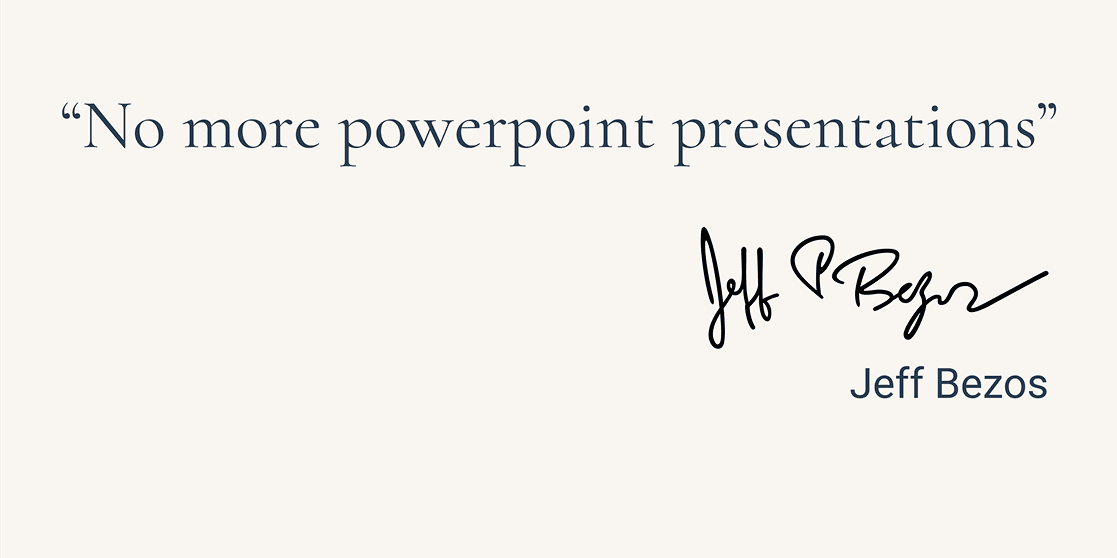
There's a reason that review has to actually be written out, not just a checklist or a card dragged from one column to another. Jeff Bezos banned PowerPoint from Amazon's senior leadership meetings for the same reason. No slides, no bullet points. Meetings started in silence, everyone reading a full written memo before anyone spoke.
The logic holds up outside Amazon too. A slide lets you put five bullet points on a screen and call it an argument, without ever showing how any of them connect. A full sentence doesn't let you get away with that. You have to actually work out the relationship between what happened and what it means, on the page, and if the reasoning doesn't hold together, it shows up immediately instead of hiding behind a bullet point or graphic.
I built that principle straight into the sprint review. At the end of each cycle, instead of a list of what got ticked off, the system writes an actual memo. Plain English, read like a proper brief rather than a status update. It's generated automatically, an AI model reads through everything that happened across the sprint and writes it up as connected prose instead of a list of completed items. It also pulls in memos from previous sprints, so what you're reading isn't a snapshot of two weeks in isolation. It's a trajectory, and you can actually see whether the last few cycles are trending somewhere or just repeating.
Sprints, backlog, and the review that closes each one out, all running on autopilot.
I built a whole productivity system for myself combining various principles and approaches like these and automated it. If you'd like it built for you, find out more at singhos.com.

SinghOS
Task Management Should NOT Be A Project Itself.
I built an automated system where I send Telegram messages — tasks, ideas, brain dumps, whatever — and it sorts each one into the right place in my Notion workspace automatically. Now I get frictionless capture, automatic morning briefings and sprint reviews. Want me to build this for you?