SinghOS
Blog
The Capture-Friction Problem: How to Get Ideas and Tasks Out of Your Head Fast.

Ranjit Singh
You're halfway through something else when the thought hits. A task you forgot, an idea for the thing you're building, a name you need to follow up with. You get maybe three seconds of clear signal before it's gone, buried under whatever you were actually doing.
What happens in those three seconds decides whether that thought survives or dies.
If capturing it means stopping, opening an app, figuring out which project it belongs to, picking a priority, writing a proper title… you're not going to do it. Not because you're undisciplined. Because the cost of capture is higher than the cost of just letting it go and hoping you remember later. You won't remember later. Nobody does.
I call this "capture-friction": the resistance between having a thought and successfully getting it out of your head and into a system. It sounds like a small thing but it really isn't. Every unit of friction you add at the point of capture cuts the number of things that actually make it into your system, and the things that don't make it in are gone. They don't queue up somewhere waiting for you to be less busy. They just vanish.
Why most systems get this backwards
Most task and project tools ask you to organise at the exact moment you're least equipped to do it. You're mid-task, mid-conversation, mid-shower-thought, and the app wants a project, a category, a due date, a priority level, before it will let you save anything. That's a lot to ask of a brain that's currently occupied doing something else.
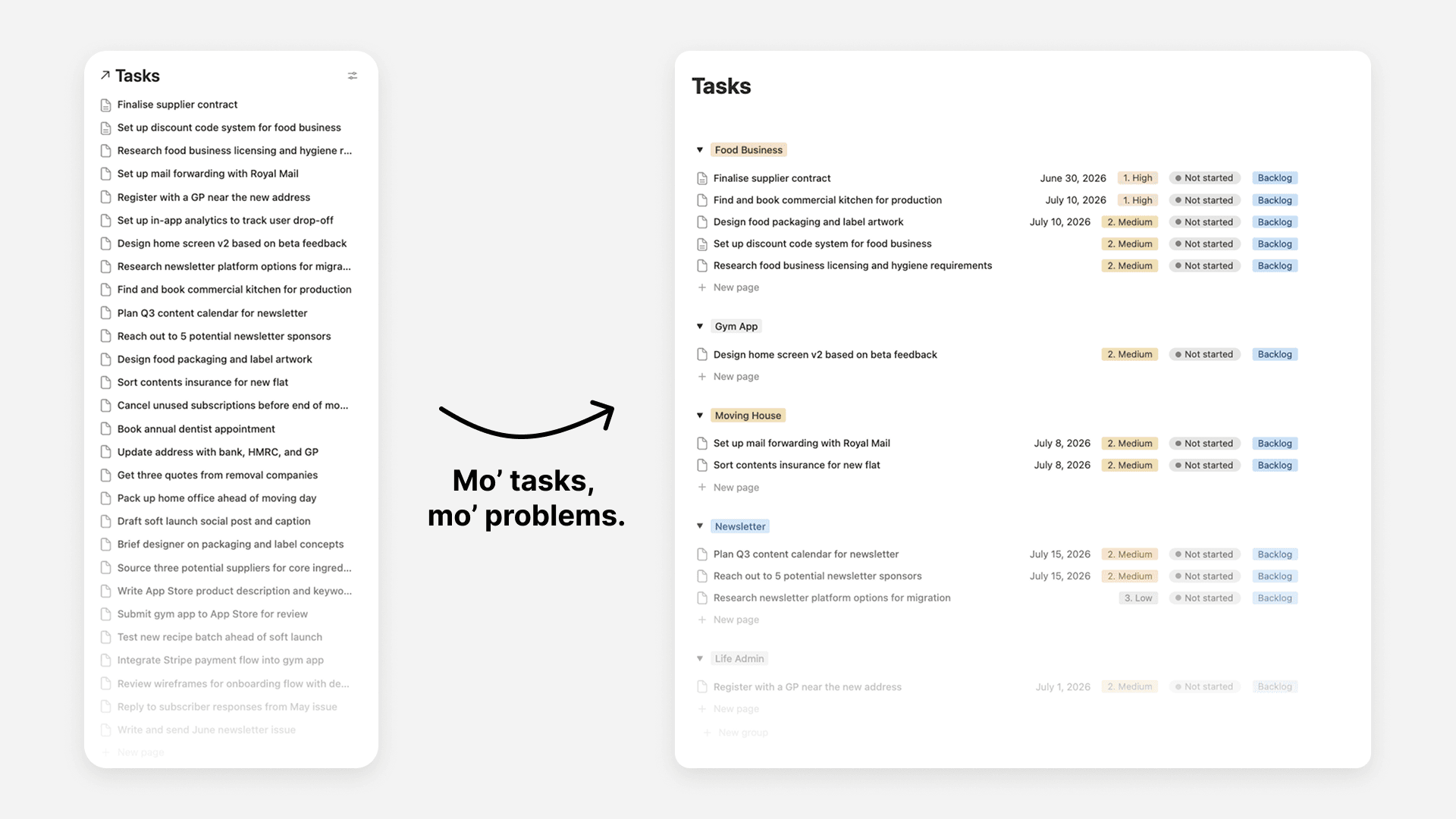
Increase complexity = increase maintenance = increase capture friction
I went through this myself. I started with a plain to-do list, which worked until it didn't. Everything piled up in one undifferentiated block and stopped meaning anything. So I added structure. Categories, projects, tags. And that killed it faster than the plain list did, because now every capture came with a small tax. Where does this go. Is it a task or an idea. What's the priority. Multiply that by every stray thought across a day and you've built a system that's more work to maintain than the problem it was meant to solve. So I stopped using it. Which is the real failure mode: not that the system was bad, but that it was too expensive to run, so I quietly abandoned it and went back to nothing.
The fix isn't a better app. It's separating two jobs.
Capture and organisation are two different jobs, and the mistake is asking one moment to do both. Capture should require exactly one decision: "is this worth writing down?", that's it. No project, no category, no priority, no title. Just get the thought out of your head and into something that isn't your memory. Organisation is a completely different task, with a completely different cognitive mode, and it should happen later, away from whatever you were doing when the thought showed up. Ideally it shouldn't require you at all.
That's the whole principle. If you're designing your own system, or sizing up someone else's, this is the test. Does capturing something cost you a decision beyond "yes, write this down"? If the answer is yes, friction wins eventually, and you drift back to nothing, the same way I did.
What this looks like in practice (where AI can be quite handy).
For me, capture is a single Telegram message. Doesn't matter if it's a task, an idea, or half a sentence that doesn't make sense yet. I send it, I get a confirmation, and I move on with whatever I was actually doing. No app switch beyond the one I already have open on every device I own. No decision about where it goes.
The organising happens somewhere else entirely, on a schedule, without me. Every fifteen minutes, everything I've sent gets read, classified, and routed into the right project with the right priority. I never do that part myself. By the time I look at my workspace, the sorting is already done. The only thing I ever had to decide, in the moment, was whether the thought was worth three seconds of typing.
That gap, between "worth writing down" and "fully organised," is where most systems lose people. Close it and the rest gets a lot easier. The cognitive load is offloaded to AI.
If you want to see what a zero-friction setup looks like end to end, I wrote up how mine works at singhos.com.

SinghOS
Task Management Should NOT Be A Project Itself.
I built an automated system where I send Telegram messages — tasks, ideas, brain dumps, whatever — and it sorts each one into the right place in my Notion workspace automatically. Now I get frictionless capture, automatic morning briefings and sprint reviews. Want me to build this for you?